
2,063 zoekresultaten voor “strw cell transplant” in de Publieke website
-
Predicting the future: Predictive control for astronomical adaptive optics
The field of exoplanet research is rapidly advancing through the development of new technology, observing techniques, and post-processing methods.
-
Chaotic dynamics in N-body systems
Promotor: Prof.dr. S.F. Portegies Zwart
-
Stellar radio beacons for Galactic astrometry
A century ago, it was unclear whether the stars in the sky were clustered in groups, or widely spread in the universe.
-
Design, implementation and evaluation of transnational collaborative programmes in astronomy education and public outreach
Promotores: Prof.dr. G. Miley & Prof.dr. J.M. van den Broek
-
Breaking the ice: constraining the volatile distribution in protoplanetary disks
This research focuses on the distribution of chemical elements in protoplanetary disks, the birthplaces of planets. These disks form around young stars and contain gas and dust, from which planets grow. Ice plays a crucial role in planet formation, aiding the clumping of dust particles and influencing…
-
Diagnostics for mechanical heating in star-forming galaxies
Promotor: F.P. Israel, Co-Promoter: R. Meijerink
-
Cosmic tomography with weak gravitational lensing
We explored the Universe using weak gravitational lensing, a phenomenon that occurs when light from distant galaxies is bent by the gravitational fields of closer cosmic objects, much like how a lens distorts light.
-
Untangling cosmic collisions: a study of particle acceleration and magnetic fields in merging galaxy clusters
On the largest scale, the Universe resembles a cosmic spiderweb. Most galaxies coexist in small groups within the threads of this web. At the nodes of the threads are enormous groups of galaxies forming the largest structures in the universe still held together by gravity: clusters of galaxies.
-
Rocked, roasted, and revealed: Lighting up dark exomoons Observational signatures of tidally induced volcanism in other worlds
The work done during this PhD research, aims to investigate the effect of tidal heatingin the observability of extra-solar satellites around exoplanets.
-
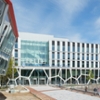 Gorlaeus Gebouw
Einsteinweg 55, Leiden
-
Tuning in to star-planet interactions at radio wavelengths
Low-mass main-sequence stars like our Sun are continuous sources of outflowing hot magnetised plasma. In the case of the Sun, this is known as the solar wind, whereas for other stars they are called stellar winds.
-
The hunt for frozen organic molecules in space
Complex Organic Molecules (COMs) have been detected in objects across different stages of stellar evolution.
-
Molecular inheritance from cloud to disk: a story of complex organics and accretion shocks
Stars like the sun are born in large molecular clouds existing from gas and dust. During the formation process, the chemical composition of the material can be altered drastically by the changing physical conditions.
-
Shining Light on Interstellar Matter
Promotor: H.V.J. Linnartz
-
Protostellar jets and planet-forming disks: Witnessing the formation of Solar System analogues with interferometry
The focus of this thesis is how stars like our Sun and planets like Jupiter, Saturn, and Earth are formed.
-
Layered loyalties: the Natuurkundige Commissie in the Netherlands Indies (1820-1850)
This dissertation, Layered Loyalties: The Natuurkundige Commissie in the Netherlands Indies (1820-1850), studies the Natuurkundige Commissie.
-
Inferno Worlds
A remarkable population of short period transiting rocky exoplanets with equilibrium temperatures on the order of 2,000 K has recently been discovered.
-
X-ray spectroscopy of merging galaxy clusters
This thesis focuses on the X-ray spectral analysis of merging galaxy clusters and the plasma code development for future high-resolution X-ray spectroscopy observations.
-
Painting with starlight : optical techniques for the high-contrast imaging of exoplanets
This thesis describes the development and validation of new high-contrast imaging techniques, with the ultimate goal of enabling the next generation of instruments for ELT-class telescopes to directly image Earth-like extra-solar planets orbiting around nearby stars.
-
Molecules during stellar formation and death
Promotor: Prof.dr. E. F. van Dishoeck
-
X-raying extragalactic gas: warm-hot gas in the EAGLE simulations
I have studied the hot, diffuse gas around and between galaxies. Specifically, I have used the EAGLE numerical simulations of galaxy formation to predict the properties of this gas, and I have used those properties to predict specific observables: soft X-ray absorption and emission lines.
-
Into the Darkness: Forging a Stable Path Through the Gravitational Landscape
In this thesis we study the landscape of gravitational models which modify GR by introducing an additional scalar degree of freedom (d.o.f.) to source Cosmic Acceleration.
-
Machine learning for radio galaxy morphology analysis
We explored how to morphologically classify well-resolved jetted radio-loud active galactic nuclei (RLAGN) in the LOw Frequency Array (LOFAR) Two-metre Sky Survey (LoTSS) using machine learning.
-
Aggravating matters: accounting for baryons in cosmological analyses
Three major cosmology-focused missions are planned for the next decade: the Euclid space telescope, the Vera C. Rubin Observatory in Chile, and the Nancy Grace Roman Space Telescope.
-
The formation of complex organic molecules in dense clouds-Sweet results from laboratory
Large areas of space are filled by molecular clouds that consist of gas and dust grains that are the remnants of dead stars. When these clouds start collapsing, the decreasing temperature and increasing density cause gas particles to start accreting onto dust grain surfaces.
-
Astrophysical plasma modeling of the hot Universe: Advances and challenges in high-resolution X-ray spectroscopy
Hot astrophysical plasma is ubiquitous in the Universe, from comets in our Solar system to the largest scale structures -- the cosmic web filaments. These hot plasmas, with the temperature of a few millions of degrees, are often observed in the X-ray wavelength range.
-
Unlocking Cosmic Depth and Detail
This thesis utilises the exceptional sensitivity and resolution of LOFAR to explore the low-frequency Universe, while simultaneously advancing the telescope's capabilities to enable new scientific discovery.
-
The interplay between stars, gas and dust in faint star-forming galaxies
When observing star-forming galaxies, we are not only seeing stellar light, but we also see how this interacts with galactic gas and dust. This thesis contains studies of the stellar, nebular and dust properties of low mass star-forming galaxies.
-
High-contrast spectroscopy of exoplanet atmospheres
More than 5,000 exoplanets have been found over the past couple of decades. These exoplanets show a tremendous diversity, ranging from scorching hot Jupiters, common super-Earths, to widely separated super-Jupiters on the planet/brown dwarf boundary.
-
Distant star formation in the faint radio sky
One of the key quests in astronomy is to study the growth and evolution of galaxies across cosmic time. Radio observations provide a powerful means of studying the formation of stars and subsequent buildup of distant galaxies, in a way that is unbiased by the presence of dust.
-
Uncovering the ingredients for planet formation
This thesis discusses the physical and chemical processes than influence the composition of forming planets.
-
Inextricable ties between chemical complexity and dynamics of embedded protostellar regions
Promotor: E. F. van Dishoeck, Co-promotor: C. Walsh
-
Het miljard deeltjes probleem
Promotor: Prof.dr. S. Portegies Zwart
-
When galaxy clusters collide: the impact of merger shocks on cluster gas and galaxy evolution
Promotor: Prof.dr. H.J.A. Rottgering
-
The Infrared Spectrum of Massive Protostars
We have conducted a full spectral line survey of the 3-13 micron region of two massive protostars, AFGL 2591 and AFGL 2136, for the first time at high spectral resolution.
-
Orchestration of Distributed LOFAR Workflows
The LOFAR radio telescope produces petabytes of data every year. Radio Astronomers use complex multi-step pipelines to process this data and produce scientific images.
-
Don't Blink: Detecting transiting exoplanets with MASCARA
This thesis describes the Multi-site All-Sky CAmeRA (MASCARA), which consists of two small robotic telescope designed to detect exoplanets around the brightest stars in the sky.
-
Lava worlds: characterising atmospheres of impossible nature
Over the last three decades, the discovery of exoplanets has revealed the boundless variety of worlds beyond our own Solar System. Majority of planetary systems contain short-period planets that are larger than Earth but smaller than Neptune.
-
The puzzle of protoplanetary disk masses
My work focuses on a class of astronomical objects called protoplanetary disks.
-
Onderzoek
Onderzoekers vanuit verschillende vakgebieden werken samen om oplossingen te bedenken voor maatschappelijke problemen.
-
 Jannis Necker
Faculteit der Wiskunde en Natuurwetenschappen
necker@strw.leidenuniv.nl | 071 5272727
-
Tram Le
Faculteit der Wiskunde en Natuurwetenschappen
nle@strw.leidenuniv.nl | 071 5272727
-
Laura Kreidberg
Faculteit der Wiskunde en Natuurwetenschappen
kreidberg@strw.leidenuniv.nl | 071 5272727
-
Emily Sandford
Faculteit der Wiskunde en Natuurwetenschappen
sandford@strw.leidenuniv.nl | 071 5272727
-
 Aurora Simionescu
Faculteit der Wiskunde en Natuurwetenschappen
simionescu@strw.leidenuniv.nl | 071 5275737
-
 Lukasz Tychoniec
Faculteit der Wiskunde en Natuurwetenschappen
tychoniec@strw.leidenuniv.nl | 31623494816
-
 Robin Hölscher
Faculteit der Wiskunde en Natuurwetenschappen
holscher@strw.leidenuniv.nl | 071 5278122
-
 Stefano Bellotti
Faculteit der Wiskunde en Natuurwetenschappen
bellotti@strw.leidenuniv.nl | 071 5272727
-
Thomas Otto Winterhalder
Faculteit der Wiskunde en Natuurwetenschappen
winterhalder@strw.leidenuniv.nl | 071 5272727
-
 Leindert Boogaard
Faculteit der Wiskunde en Natuurwetenschappen
boogaard@strw.leidenuniv.nl | 071 5275816