
Verslag lunchbijeenkomst: Hoe beïnvloeden sociale ongelijkheid en ongelijke machtsverhoudingen de gezondheid?
How do social inequality and unequal power relations shape health, and what is needed to make global health more just and inclusive? These questions formed the starting point of a lunch meeting introducing the Leiden University Network for Health in Africa (LUNHA). The meeting was opened and moderated by Annemarie Samuels, who welcomed participants and positioned the discussion within Leiden University’s broader efforts to address health and wellbeing through interdisciplinary collaboration.
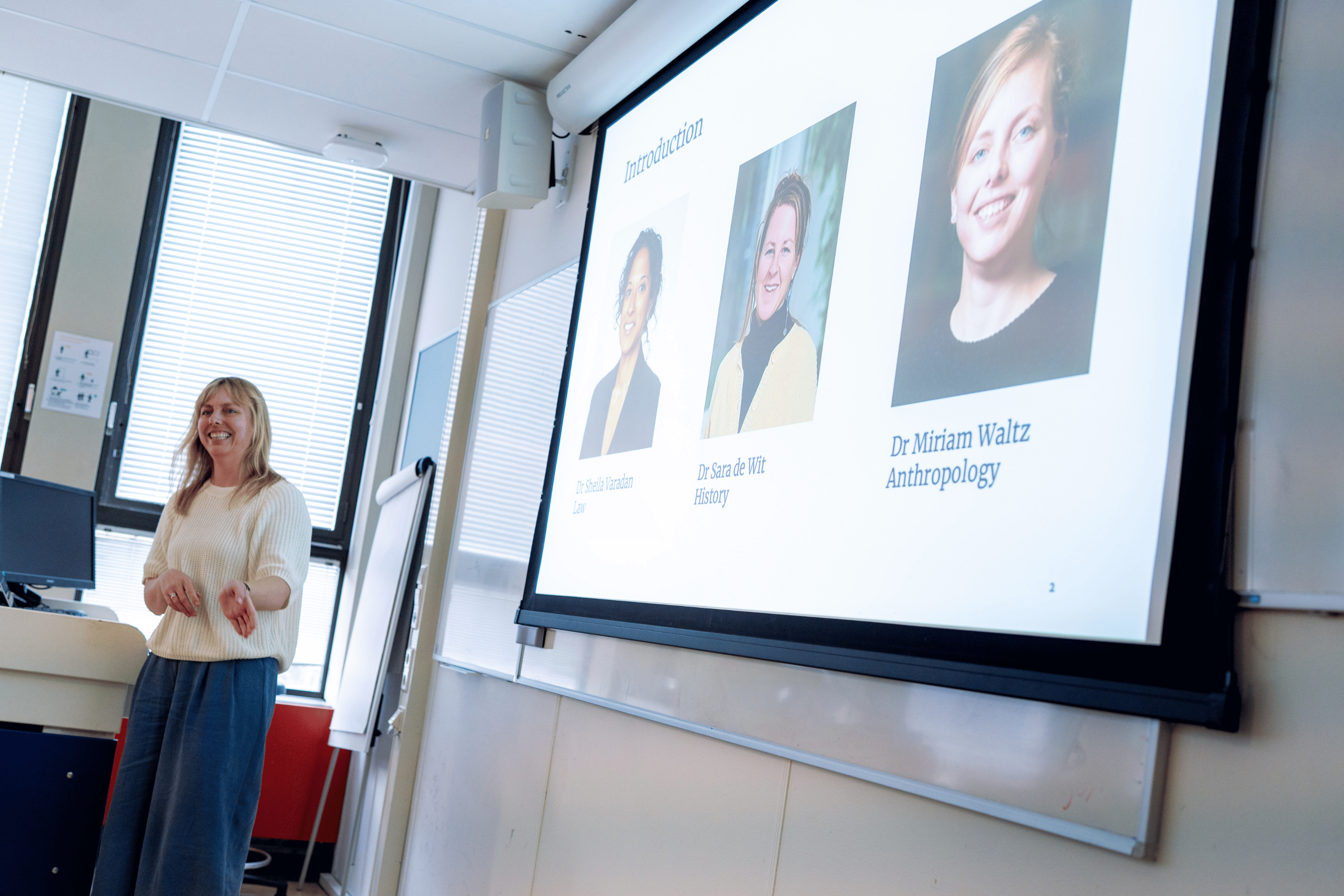
Through presentations by Miriam Waltz, Sheila Varadan and Sara de Wit, participants were invited to explore health not only as a biomedical issue, but also as a social, political, historical and legal one.
LUNHA: Bringing disciplines together for global health
LUNHA was established as an interdisciplinary network connecting researchers from the Faculty of Social and Behavioural Sciences, the Faculty of Law, the Faculty of Humanities, and the African Studies Centre Leiden. The network emerged from the SSH Sector Plans and combines Leiden University's thematic focus on health and wellbeing with its long-standing expertise on Africa. Beyond facilitating research collaborations, LUNHA aims to strengthen knowledge exchange and shape the direction of global health research, particularly in Africa.
Rethinking global health through four core sensitivities
Miriam Waltz outlined the network’s approach, which is guided by four core sensitivities. First, global health should be understood as more than a technical or medical challenge; policy, technologies and everyday practices interact to shape health outcomes. Second, questions of justice, equity and inclusion must be central to health research and policy. Third, health inequalities should be approached holistically by acknowledging and studying how they are connected to ecological challenges and broader forms of social inequality.
Finally, researchers need to critically examine power differentials within global health, including the ways in which institutions in high-income countries often set agendas. A key ambition of the network is to move towards co-production of knowledge and equitable forms of collaboration, in which communities directly affected by the topics of study are in the lead.
Climate, planetary justice and indigenous knowledge
Sara de Wit illustrated these themes through her work on climate and planetary justice. She highlighted how health in Africa is intertwined with global processes such as resource extraction, land appropriation and climate change. Drawing on examples from biodiversity conservation and climate research, she showed how indigenous knowledge systems are frequently marginalised, despite their potential value. Current projects explore how different forms of knowledge—from meteorological science to local environmental expertise—can be brought into dialogue. Such initiatives challenge dominant narratives and encourage more inclusive approaches to environmental and health governance.
Antimicrobial resistance beyond biomedicine
Sheila Varadan focused on antimicrobial resistance (AMR) and the importance of incorporating perspectives from the social sciences, humanities and law into what is often treated as a primarily biomedical issue. Describing an international research collaboration involving experts from a wide range of disciplines, she demonstrated how social inequalities and power relations influence both the causes of and responses to AMR. Her presentation underscored the importance of long-term engagement and interdisciplinary dialogue when addressing complex health challenges. Legal perspectives, she argued, can help identify and mitigate forms of injustice that may otherwise remain overlooked.
Towards more inclusive global health research
The discussion highlighted the importance of questioning who defines health priorities and whose knowledge counts in research and policymaking. Participants reflected on emerging approaches such as community-led research, in which local communities play a leading role in setting research agendas and defining priorities. The session concluded with an invitation to build new collaborations through LUNHA and to contribute to a more just, inclusive and interdisciplinary global health agenda.